A home stays calm the same way it stays sound: small problems are handled before they become big ones.
I combined the quiet household habits my family practiced in Japan with what close to thirty years maintaining American homes taught me about prevention. Then I wrote one hundred of those methods down, room by room.
Instant PDF download · Visa · Mastercard · PayPal · Apple Pay · 7-day money-back guarantee
If your home feels like a chore that never finishes, you do not have a discipline problem. You have a method problem. You were taught to clean the one way that guarantees it never stays clean — as a big job you do after the mess has already won. So you keep paying for the same clean week after week, and it never lasts.
You give up a weekend morning to undo a week of mess. Three days later the house looks like you never touched it. You are not keeping a clean home — you are renting a few clean days at a time, and the rent always comes due.
A different spray for every surface, half of them used once. The cabinet under the sink is overflowing, your home is no cleaner for any of it — and somehow you are still adding to the shopping list.
The pile on the counter. The laundry on the chair. You walk past them twenty times a day, and each time they take a little from you — not minutes, but attention. The mess is exhausting before you ever touch it.
You finally decide to "get organized," so you buy the bins, the baskets, the label maker. A month later you own everything you owned before, plus the containers — the same clutter, now in nicer boxes.
None of this is your fault. But it is your pattern — and a pattern is just a method you never chose on purpose. Change the method, and the whole thing quietly stops.
My name is Kenji Tanaka. I am originally from Japan, and I moved to the United States with my wife, Yuki. I have spent close to thirty years maintaining and repairing American homes, seeing which small problems disappear with a simple routine and which ones become expensive after they are ignored.
The Japanese household habits practiced by my family—and by Yuki's family in Tohoku—begin from the same idea: do the small thing at the right time. The home becomes easier to clean because dirt, clutter, and wear are stopped before they become weekend projects.
The price of a messy home is rarely the mess. It is the weekends, the products, and the low hum of guilt that follows you from room to room.
The methods in this book cost almost nothing to run. Most use things already under your sink. The Manual pays for itself the first time you skip a cart full of cleaning products you were about to buy.
One hundred methods across nineteen sections — every room, every routine, every habit, with the products, the costs, and the step-by-step. A 593-page manual you can read one chapter at a time over morning tea.
The invisible system that stops mess before it forms.
Why Japanese homes stay empty — and yours fills up.
Everything has a home. Everything returns to it.
The room that dirties fastest, kept clean the quiet way.
White, dry, and odor-free — without scrubbing.
Cleaner clothes, longer life, far less money.
Floors, walls, windows, and the air itself.
A home that smells clean without a single plug-in.
Why bugs and rats avoid a Japanese home.
Curb appeal that maintains itself.
Stay cool through summer without the power bill.
The few tools that quietly eliminate daily effort.
Plain chemistry that replaces a cabinet of sprays.
The philosophy underneath every habit.
The room becomes a ritual. The ritual becomes peace.
The home changes with the seasons. So do the habits.
Repair before replace — the old way that lasts.
Waste nothing. Save everything.
Store it right, waste nothing, eat everything.
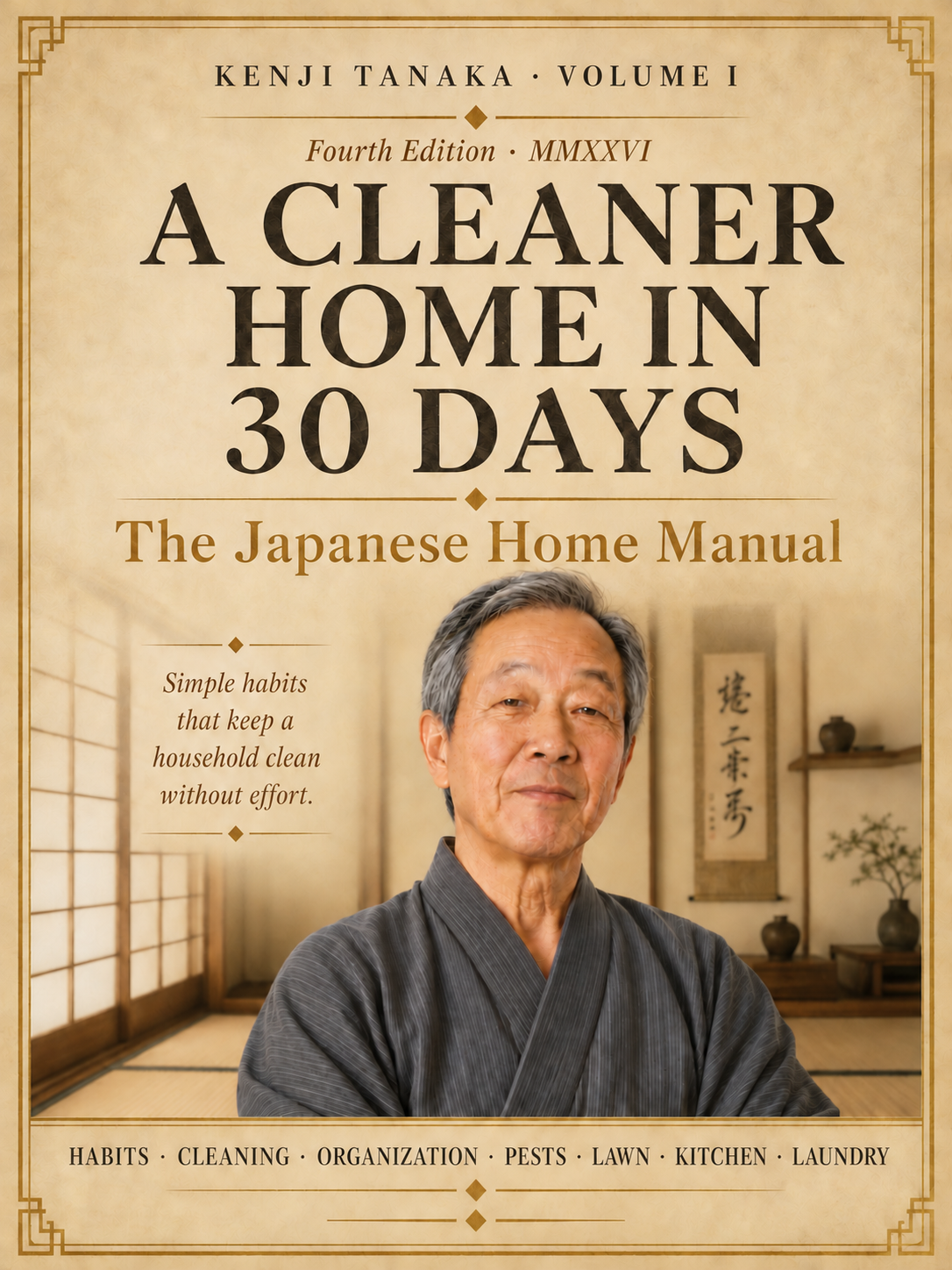
I am originally from Japan and moved to the United States with my wife, Yuki. For close to thirty years, I maintained and repaired American homes. That work taught me how often an expensive problem begins as one small thing no one handled early.
My family in Japan and Yuki's family in Tohoku approached the household in much the same way: notice early, use what you have, waste little, and keep a simple routine. This manual brings those traditions together with the practical lessons I learned inside American homes.
— Kenji Tanaka

Instant access · Visa · Mastercard · PayPal · Apple Pay · 7-day refund
Buy the Manual, read it, and try a single habit for a week. If your home is not calmer and easier to keep, reply to your receipt within seven days and I will refund every cent. You keep the book. The risk is entirely mine.
A 593-page PDF — one hundred methods across nineteen sections, every room and routine of the home, each with its real products, costs, and steps, fully illustrated. Plus a 30-day challenge, room-by-room logs, and a habit tracker.
It is an instant PDF download the moment you buy. Read it on any phone, tablet, e-reader, or computer. It is yours to keep forever, with free updates to future editions.
No. Almost every method uses things you already own or can buy at any grocery store — vinegar, baking soda, a cloth. The whole point is to spend less on products, not more.
The habits are simple — that is the point. What most people are missing is not effort but the small system that makes a clean home automatic. If you already keep an effortlessly clean home in five minutes a day, you do not need this book.
Yes. These methods are principles of timing, prevention, and placement—not rules for one particular floor plan. They can be adapted to an apartment, a suburban home, or a larger house one room at a time.
Then you pay nothing. You have seven days to ask for a full refund, no questions asked, and you keep the book.
Start keeping it clean every day — in less time than it takes to make a cup of tea. One hundred methods. Yours for $37, forever.
Get the Manual · $37Instant download · 7-day money-back guarantee